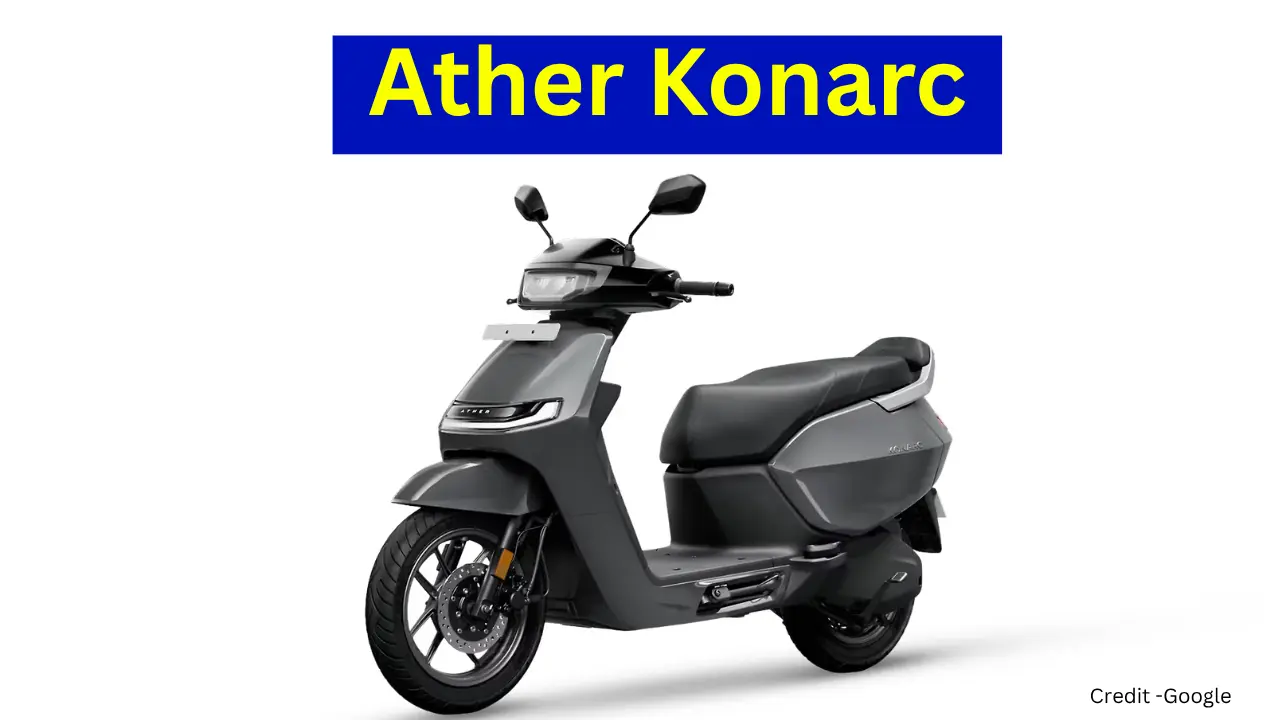
Ather Konarc: The Indian electric two-wheeler market is becoming increasingly competitive, with manufacturers focusing not only on performance and range but also on comfort, technology, practicality and affordability. In this rapidly changing market, Ather Energy has introduced the Ather Konarc, a new electric scooter designed to appeal to everyday Indian commuters.
The Konarc represents a significant step for Ather because it moves the company further into the mass-market electric scooter segment. Rather than focusing exclusively on sporty performance, the Konarc has been developed around practicality, comfort, usable range and modern technology. With multiple battery options, a claimed range of up to 161 km on the currently announced versions and a starting price of around ₹1 lakh, the scooter aims to attract customers looking for a dependable electric alternative to conventional petrol scooters.
Modern and Practical Design
The Ather Konarc has a distinctive design that reflects its focus on everyday usability. While Ather’s earlier scooters have generally been associated with a sporty and youthful character, the Konarc takes a more practical approach.
The scooter uses a metal body and steel unibody chassis, giving it a solid construction. Its proportions are designed to provide stability and comfort during daily commuting. A long 1,352 mm wheelbase contributes to a planted riding experience, while the large front wheel and long-travel suspension are intended to handle broken roads and uneven surfaces more comfortably.
The Konarc gets a 14-inch front wheel and a 12-inch rear wheel. The suspension setup includes approximately 90 mm of travel at the front and 100 mm at the rear. These characteristics are particularly relevant for Indian roads, where potholes, speed breakers and rough patches are common.
Overall, the design philosophy of the Konarc is clear: it is built to be comfortable and practical rather than aggressively sporty.
Battery Options and Range
Range is one of the most important factors for consumers considering an electric scooter, and Ather has addressed this by offering different battery configurations.
The currently announced Konarc S range includes three versions. The entry-level Konarc S 100 uses a 2.1 kWh battery and has a claimed IDC range of 100 km. The Konarc S 125 features a 2.7 kWh battery and offers a claimed 125 km of IDC range. At the top of the currently available range is the Konarc S 161, which gets a larger 3.5 kWh battery and a claimed range of 161 km.
Ather has also indicated plans for a version capable of delivering a claimed 200 km IDC range.
The claimed range figures are based on standardised testing conditions, so actual range in everyday riding can vary depending on factors such as speed, riding mode, traffic, rider weight, road conditions and temperature. Nevertheless, the availability of several battery options gives customers greater flexibility.
The scooter’s claimed top speed on the currently announced S variants is around 70 km/h, which is sufficient for typical urban commuting.
Charging Technology
Charging convenience is another important consideration for electric scooter buyers. Ather has equipped the Konarc with a 450W onboard charger, while an additional charger can increase the combined charging capacity to approximately 1.35 kW.
According to Ather, the faster charging setup can charge the S 100 from 0 to 80 percent in roughly two hours.
For an urban commuter, this can be useful because the scooter can potentially be charged during periods when it is parked at home. However, charging times can vary depending on battery size, charging equipment and operating conditions.
The focus on improving home-charging convenience is important because charging infrastructure remains one of the major factors influencing electric vehicle adoption in India.
Technology and Features
Technology has always been an important part of Ather’s identity, and the Konarc continues that approach.
The scooter offers several features intended to make everyday riding more convenient. These include AutoHold, which can help keep the scooter stationary without requiring constant brake pressure, and Park Assist Reverse, which can make manoeuvring easier in tight parking spaces.
The Konarc also supports connected features through Ather’s software ecosystem. Depending on the variant, riders can get features such as navigation, vehicle information, theft and tow alerts, and over-the-air software updates.
Google Maps integration on higher variants adds another useful feature for daily commuters. Instead of relying entirely on a smartphone mounted externally, riders can access navigation information through the scooter’s integrated technology ecosystem.
Other practical features include USB Type-C charging and under-seat lighting.
Storage and Everyday Practicality
One of the strongest aspects of the Konarc is its emphasis on practicality. The scooter provides around 31 litres of under-seat storage, giving riders useful space for carrying everyday belongings.
Storage is especially important in the Indian scooter market because customers often use their scooters for a wide range of activities, including commuting to work, shopping, college travel and family errands.
The Konarc’s practical design therefore gives it a potentially broad customer base. It is not intended only for enthusiasts or technology-focused early adopters; it is designed to function as a regular everyday scooter.
Safety
Safety is another area where Ather has attempted to differentiate the Konarc.
The upcoming Z variants are expected to feature Ather’s Advanced Electronic Braking System (AEBS). This technology electronically manages braking and is designed to provide greater control during braking situations.
The scooter also uses an IP67-rated permanent-magnet synchronous motor and an IP67-rated battery pack. The battery is housed in an aluminium casing, adding another layer of protection for one of the vehicle’s most important components.
While specifications and electronic safety systems are useful, actual safety also depends on tyres, braking hardware, suspension, rider behaviour and road conditions. Nevertheless, the inclusion of advanced electronic systems shows the direction in which modern electric scooters are developing.
Pricing
The Ather Konarc has been positioned more competitively than some of the company’s premium offerings.
The Konarc S 100 starts at approximately ₹99,999 ex-showroom in Bengaluru, while the S 125 is priced at around ₹1,21,999 and the S 161 at approximately ₹1,44,999. Prices may vary depending on location, taxes, subsidies and other applicable charges.
This pricing strategy is important because the electric scooter market is no longer limited to premium buyers. Customers increasingly expect electric scooters to provide good value while still offering modern features.
The availability of different battery capacities also allows buyers to select a model according to their budget and range requirements.
Maintenance and Ownership
Electric scooters generally have fewer mechanical components than internal-combustion scooters, and the Konarc follows this general advantage.
Ather has announced a service interval of approximately 10,000 km or one year, whichever comes first. Longer service intervals can be attractive to customers who want a low-maintenance vehicle for regular commuting.
Battery warranty is another important factor when buying an electric scooter. Ather offers extended battery protection options through its ownership packages, giving customers additional reassurance about long-term battery ownership.
For buyers considering an electric scooter, however, warranty terms, charging availability, service-centre coverage and battery replacement costs should all be considered alongside the initial purchase price.
How Does the Konarc Fit Into the Market?
The Ather Konarc enters a market that already includes several established electric scooters. Models such as the TVS iQube, Bajaj Chetak and other offerings from major electric two-wheeler manufacturers compete for the same customers.
The Konarc’s main advantage is its combination of Ather’s technology-focused approach with a more practical and accessible scooter format.
Its long wheelbase, large front wheel, generous storage capacity and multiple battery choices make it particularly suited to people who want an electric scooter for everyday use rather than high-performance riding.
At the same time, competition in this segment is intense. Customers are increasingly comparing scooters on real-world range, charging time, after-sales service, battery warranty, software features and total ownership cost rather than simply looking at the claimed range.
Conclusion
The Ather Konarc is an important addition to Ather Energy’s electric scooter portfolio. It represents a move toward a broader customer base by combining practical design, multiple battery options, modern technology and competitive pricing.
Its claimed range of up to 161 km on the currently announced variants, with a planned 200 km version, gives buyers a choice based on their daily travel requirements. Features such as AutoHold, Park Assist Reverse, connected technology, navigation, USB Type-C charging and 31 litres of storage further strengthen its everyday appeal.
Perhaps the most significant aspect of the Konarc is its philosophy. Instead of treating an electric scooter as simply a high-tech replacement for a petrol scooter, Ather is attempting to create a product that combines technology with the practical requirements of Indian commuters.
The real test, however, will come from everyday ownership. Real-world range, charging convenience, reliability, after-sales service and long-term battery performance will ultimately determine how successful the Konarc becomes.
If Ather can deliver on these areas while maintaining competitive pricing, the Konarc has the potential to become a significant player in India’s increasingly crowded electric scooter market.
Read More-